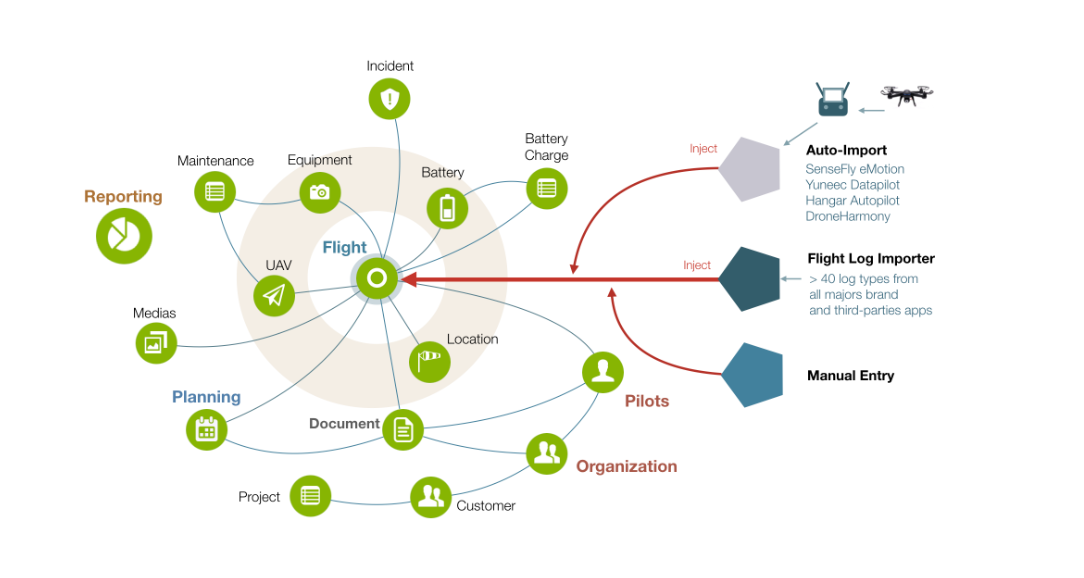
To us, this showed that drone logbook was able to advertise what their software could do, while Measures advertisement is much more broad and less specific. There were no specific graphics on their site that showed what it could do. But all this could only be due to the fact that we have not been able to utilize the software. We haven’t been able to fly yet so there could be features that are only accessible once flights have started. We will find out more once we have flights in. Below (Fig 2) is the beginning of what our poster is going to look like, we still need more data on CRM and both software's before we can make more concrete conclusions.

Monday, February 25, 2019
Week 7
Since we are still unable to fly in the field we are still working on posters and doing dry runs. This week poster work was the main focus. Me, Kyle, and Thomas are doing our poster on crew resource management and the big differences between Purdue's Drone Logbook and Measure. When looking at both the sites, Drone logbook seemed to have many more features. Checklists, times flown, operators, drones, inventory lists...etc the list goes on. It may need some more work to be more user friendly but it does have many useful features. We haven’t been able to use Measure so we don’t know what can go on the site. This impeded our ability to accurately judge both, the only aspect that we didn’t like was its lack of features. The site didn’t seem to have any tools, or at least any that we could find. We looked on Measures website to see what they claimed to have and still found nothing. On drone logbook we found a graphic with lots of claimed to have features. (Fig 1)

Monday, February 18, 2019
Week 6
In week 6, I was able to inventory the rest of the batteries for the DJI M600. The flight teams have been created based on what day/time they were able to fly, with the exception of Krysta. She has a revolving work schedule, meaning she sometimes works different days of the week. After looking at the times for our class to fly, there may need to be some changes. Most days a group of 3 or more can only be together for 1 hour. This is unreasonable because just getting the equipment and ground control station setup can take an hour. Those who are able to fly the most will be on the Bramor airframe. This is due to the complexity of the preflight checklist. I want to keep a flight crew specially for the bramor. This airframe is very costly and cannot afford small mistakes. One way of working everyone into the Bramor team is to switch out one of the team members on it. So if the team were to have 3 people. Person 1 & 2 would always be on the team but person 3 would be switched out with the other members. This would ensure everyone would have the chance to gain familiarity with it without significantly increasing the chance of an incident. There is still the issue of people simply not having the time to be able to fly, but that will have to be discussed in more depth. Since the weather is still unflyable we have been tasked with creating posters for the SATT poster symposium. In my group is Kyle and Thomas. Our poster idea revolves around flight crew and crew resource management (CRM). For our poster we will talk about how CRM is utilized in UAS operations, this is a key role for these type of operations. We have not been able to discuss the poster more throughly, but we will be working on it solely next week.
Sunday, February 10, 2019
Week 5
During week 5, we had a dry run test for mission operation. What this consisted of is a theoretical mission that needed to be completed. As a team, we decided where the best location of our test site (West Lafayette Amphitheater) would be for a major flood. As a team, we chose what platform we would use, what day would be best suited, and how we would perform the mission. We picked out one of the shape files on our map then proceeded to choose a location where we would launch our aircraft. Since the mission would be to capture flooding, we would be utilizing an RBG camera with the highest resolution as possible. Which meant using the Bramor with its normal RBG camera. Theoretically before hand we would have video of the site area. Since we would have both, we would be able to compare the results before and after. We could also compare our results to the Tippecanoe GIS maps. The test run was a great idea and showed us a lot of could be flaws in our operation. We still need to work out minor flaws but the dry run was a success in showing us how we would do this operation if it came to be.
During this week I also continued to pack parachutes for the Bramor. Since the parachute is the main method of landing for the Bramor, it is of paramount importance to get this up and running. Still waiting on the Bramor to create a checklist and its appropriate documents.
Tuesday, February 5, 2019
Week 4
Due to inclement weather, class was cancelled on the day we planned to try out a dry run of our operation. What we had planned to do was get everyone together and simulate an operation. We would simulate us going out into the field to gather data from our test site. Since we wouldn't be flying, we would load an SD card onto the platform with data already on it. Then we would act as if we just came from from the field with all of our data. The flight team would then organize the data correctly and put it into the correct folder for data processing. This dry run would show us, as a class, what processes could be further developed or improved. A dry run would also give us a good feel as to how the operation should feel once we get into the real flights.
As for the flight engineering, Ryan has made an M600 checklist that he has put on drone logbook. We have reviewed the checklist but still need a dry run to test it out.
Monday, January 28, 2019
Week 3
Due to extended delay on C-Astral's Bramor, I switched my focus from parachute packing and creating an instructional video for it. Me, Ryan and Ian started to brainstorm a checklist for the M600. We also started to inventory our equipment. The M600 has a total of 18 batteries separated into 3 groups of six. To ensure we use the same six batteries together they are labeled different colors. Yellow, blue, and purple were the colors chosen. While we started to make a list we decided that using QR codes to label the battery would be a good idea. I made QR codes for 6 of the batteries and have them saved.
The class also started using drone log book, which will ultimately help me with creating checklists and inventory lists. The site has its own category for flight, maintenance, inventory, personnel, documents and incidents. Drone logbook will be very useful for in field use of checklists and flight records. Planned for next week is creating a checklist for the M600 on drone log book itself, this will help condense all of the classes resources down to a few sites. If any maintenance is done on any of the platforms we have a section dedicated to jot down any notes or major maintenance done.
Thursday, January 24, 2019
Week 2
As the lead flight engineer I was tasked with learning to pack the parachute for the Bramor. For this week me and systems integrator, Ian Wiley practiced packing the parachute. The packing guide consisted over 35 steps. We first started out by hand deploying the parachute, after that we made room on a desk so we could have room to fold it. Step by step, me and Ian followed the procedure taking notes of what would be good to have in an instructional video. We were able to pack it twice during the time of our lab. The first time packing was much more difficult than the second, due to us never packing this parachute before. The most difficult part we agree would be the most important part. The weaving of the cords at the end. If the cords are tangled then the parachute could have a chance of not being deployed, causing the Bramor to potentially take a very hard landing. This is the step me and Ian are working on the hardest due to the difficulty of it.
![]() |
| Bramor Parachute packed (the most important aspect is the cords being woven correctly so it deploys) |
![]() |
| Bramor Parachute during packing (1st attempt) |
![]() |
| During this phase of the packing, we separated the 8 gores into a neat pile. |
Monday, January 14, 2019
419 Capstone Preparation
In our first week of class, the class had discussion on how to classify the data we collect from our flights. Evan, as the data analyst, had two options that were discussed. In the photos below he drew out how the data would be organized. In class we also set up folders for our own use in this class along with mapping a drive.
Here on the left is the diagram on how data will be collected, stored, and released. There is also the naming convention for the data on the right hand side of the photo. This was the main topic of discussion and took us most of the time.
For my job, I was able to see the parachute and look into the folding of it. We received the Bramor user manual and in it was the guide to packing the parachute. It consisted of 35 steps.
Subscribe to:
Posts (Atom)


